Vigorously Lazy

with Christopher Heavener

Blog

Thursday, March 25th

Digital Display.

Picture 13

[switch the blond with a 13-year-old version of myself masturbating and the shadowy figure to my mom walking in on me, then yeah, that’s a pretty accurate title]

Issue Six contributor Charles Bergquist sent this one in to me this morning asking me what I think about this type of thing.

I wrote back:

This is really cool. It looks expensive as shit though. I don’t see an immediate demand for it either. That looks like it costs along the same lines as a commercial/short film for one of those fancy vodka or car companies. I don’t see many magazines (even the upper echelon ones) having the change to dump into stuff like this. It’s like a concept car: looks really cool, totally impractical and an idealized version of what the future holds.

What do you think? Am I being cynical or is it safe to assume that everyone in publishing is on the brink of financial oblivion?

Thursday, March 25th

Issue Six Preview: Baron von Richtofen Flies Again.

Reflection-for_Annalemma copy

The following is an excerpt from the story Baron von Richtofen Flies Again by Ryan Call, appearing in Annalemma Issue Six. Image by Jenny Kendler.

The first two deaths, a pair of gerbils on loan from the school, had sent his children into outrageous fits of mourning. They wandered around the house that weekend, eyes bloodshot and noses runny from weeping, and bumped into walls, collapsed facedown on the couch, across chairs, flailed their limbs, refused to eat their dinners, whimpered in bed at night. His wife suggested he try to distract them with some fun activity, like maybe an arts and crafts project? So Gary led them in cutting armbands out of a pair of old, black athletic tube socks he found at the bottom of his underwear drawer, and these the children delighted in wearing to school the following week.

During the parent teacher conference, he offered to purchase a new set of gerbils. Maybe there existed a hardier breed, one better suited to the repeated, but no less affectionate attention of young children in the process of developing the finer action of their motor skills?

I’m afraid the issue is not one of money, but of morale, his children’s teacher said.

The entire first grade, all three homerooms, had apparently taken to wearing some form of black armband, and would he know anything about that?

Perhaps a pair of guinea pigs then, he said.

To continue the story, click here to pre-order Annalemma Issue Six, which ships April 12th, 2010.

Ryan Call‘s stories appear or are forthcoming in Hobart, Caketrain, Mid-American Review, Lo-Ball, New York Tyrant, and elsewhere. He and his wife live in Houston.

Jenny Kendler was born in 1980 in New York City. She graduated summa cum laude with a BFA from the Maryland Institute College of Art in 2002, and received her MFA from the School of the Art Institute of Chicago in 2006. She currently lives and works in Chicago.

Wednesday, March 24th

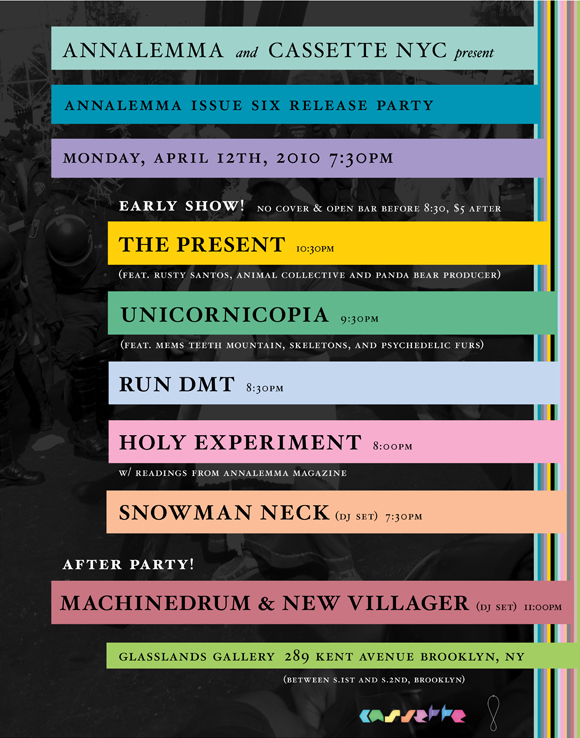
Annalemma Issue Six Release Party.

Annalemma_Six_Party copy

UPDATE: Now with sexy party flyer. Thanks Jen!

In a manner befitting Issue Six‘s theme of sacrifice, we’re throwing a lavish and decadent party in Brooklyn to celebrate the release of our latest and greatest.

Mark your calenders for Mon., April 12th, 7:30pm.

The line-up:

The Present (fronted by Animal Collective producer Rusty Santos)

Unicornicopia (with members of Teeth Mountain, Skeletons and Psychedelic Furs)

RUN DMT

Also:

readings from the magazine accompanied by reverb/noise princess Holy Experiment.

Live performances are from 7:30pm-10:30pm.

Oh yeah, and don’t forget the after party with DJ sets from Machinedrum and New Villager.

Monday April 12th, 2010
Doors @7:30pm
OPEN BAR from 7:30pm-8:30pm
NO COVER before 8:30pm, $5 after

It’s all going down at Glasslands Gallery 289 Kent Ave, between s.1st and s.2nd street in Williamsburg 718-599-1450

See you there!

Tuesday, March 23rd

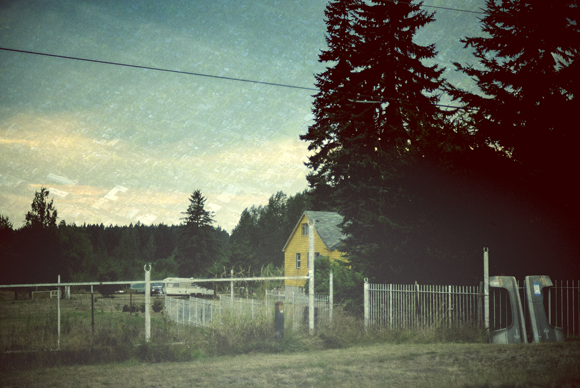
Issue Six Preview: Goodnight, America.

dl_03 copy

The following is an excerpt from the story Goodnight, America by Jack Boettcher, appearing in Annalemma Issue Six. Image by Daniel Lucas.

“Carol, word this evening that a bridge has collapsed over the Coosa River. There were several injuries, but only one person died.”

“Dan, bless those poor onlookers. Can you imagine?”

“I see the bridge crumbling into the river like a shelf of shale touched by our Lord’s pointer itself, Carol.”

“It’s just awful isn’t it.”

“Carol. Like, no, I can’t even begin to. Uh. Us boys used to jump off that bridge into the river at night, wearing nothing but the suits we wore to the interview with God before we were born, so obviously I have some very tender like feelings for that bridge, but we have to press on, we have to fight, we have wars going on right now. Which reminds me, folks, you can donate cigarettes and old battery-operated handheld video games for the troops to our offices, at any time you wish, call…”

*

You think about letting go and floating out on the invisible wires of a wind shifting direction, on summer nights with the river drawing up fast beneath you. But with the air so humid that it was like you were already falling through something like water, and until you hit the quick black surface and went swift and away you never knew what the water really was. And you get distracted before the bright lights and the camera, you have to read the cards twice, and then you read things that aren’t on the cards at all, textual gaps and illusions into which you stumble. From that warm and rust-rough footing your tiny toes gripped, you could smell the blasts off the steel furnaces and see the deer sleeping on the banks below, color of simply smoke, not yet skittish because the first boy hadn’t jumped and cracked the hushed rush of the current. You honestly believe the world had the exact number of people it was supposed to have back then, as your mother also professes. Whichever path you took from home, in any direction, the wilderness always clung as snug against you. Now there are paved roads and sodium lights for the teenagers to find their ways home. You were drunk on that bridge above the river and you were so young and drunk that the stars prickled through the brine into your pores and stung like the horseflies that were actually stinging you. You flailed above the water like some hapless new mammal with pawn shop wings and all those comets reached across the sky to bite you in the ass. You swatted away horseflies midair. A wonder you never cracked your skull: people scavenged metal and trash from that river for a living.

Click here to pre-order Annalemma Issue Six, which ships April 12th, 2010.

Jack Boettcher is the author of two chapbooks of poetry, most recently The Deviants (Greying Ghost Press 2009). His stories and poems have appeared or are forthcoming in Boston Review, Denver Quarterly, Fence, Indiana Review, Pleiades, and other magazines. He lives in Austin, TX.

Daniel Lucas is an artist & graphic designer working and living in luscious Los Angeles. A graduate from the CalArts program, he – like so many other graduates – still has little, to no, idea where he is going in life. This is the most exciting thing about it all to him. 

Monday, March 22nd

Corium Magazine.

Picture 4

Contributor Lauren Becker, along with notable writers Greg Gerke and Heather Fowler, recently unveiled Corium Magazine, a new online journal with a simple design and some damn fine writers published in their first issue.

I’ve only read Sean Lovelace’s Bonnie and Clyde piece so far, an inspiring take on the genre of historical fiction. Looking forward to reading Stephen Elliott and Alec Neidenthal’s piece soon.

Bookmark Corium today. There’s sure to be some quality stories coming from them in the near future.

Well done, Lauren, Greg and Heather. Welcome to the fold.

Monday, March 22nd

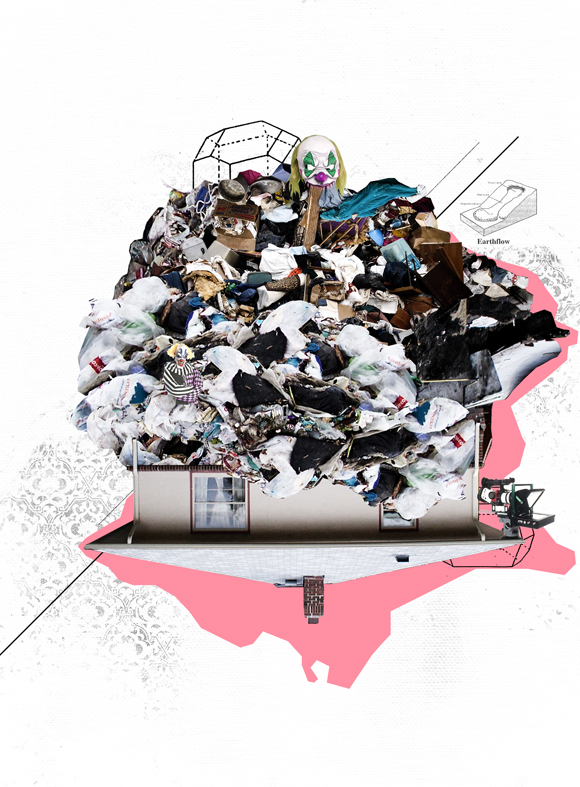
Issue Six Preview: Ashore, an Island.

Island2-black copy

The following is an excerpt from the story Ashore, an Island, by Jonathan Messinger, appearing in Annalemma Issue Six. Image by Ghazal Hashemi.

My mother didn’t understand that Dominica was a different island than the Dominican Republic, so in the months leading up to the belated honeymoon she would say, “Kyle is finally going on his honeymoon,” she’d say, “to the Dominican Republic.”

And you would think it would be that finally, the inherent judgment of adverbs, that would have driven my brother crazy. But because my mother had entered this age of enlightenment, we all knew the finally came more from relief for her hard-working son than it did from admonishment.

Instead, it was her persistent confusion of the French Dominica with the Spanish Dominican Republic that made of my brother a red-eyed maniac.

“It’s Dominica, ma!” he’d yell.

“That’s what I said,” she’d calmly respond.

“It’s different. It’s not the Dominican Republic. It’s a totally different island.”

“Well, I don’t know, I don’t know,” she’d sing-song, not wanting a fight.

It progressed past the point of civility, to where my brother and mother no longer spoke to each other. And suddenly there was a need for me, the little brother without a wife, without a steady job and without the ambition to find one. Suddenly the family warmed to me, which was a new sensation. While my family froze each other in the chambers of their bruised love, I was treated like a freshly delivered pizza, or, whatever makes families happy these days.

I have to confess, I didn’t know why my brother lost his cool over my mother’s confusion. She’d always had weird language hiccups, and yes they could be frustrating, but they’d always been something of a joke for our family, the way families laugh at our balding fathers or our nephews with heads shaped like vegetables. Kyle never lost his cool when my mother consistently called a piña colada a pina calooda or the famous comedian Jerry Seinfeld Jerry Steinfield.

Click here to pre-order your copy of Annalemma Issue Six, which ships April 12th.

Jonathan Messinger is co-publisher of featherproof books, books editor of Time Out Chicago, and co-founder of The Dollar Store reading series. He’s the author of the story collection Hiding Out, and is at work on the next in the series: Hiding Out 2: Hiding In and Hiding Out 3: Don’t Stop Hiding.

Ghazal Hashemi is an artist and writer born in Tehran, Iran. She is currently living in a beach town the size of a shoe box.

Friday, March 19th

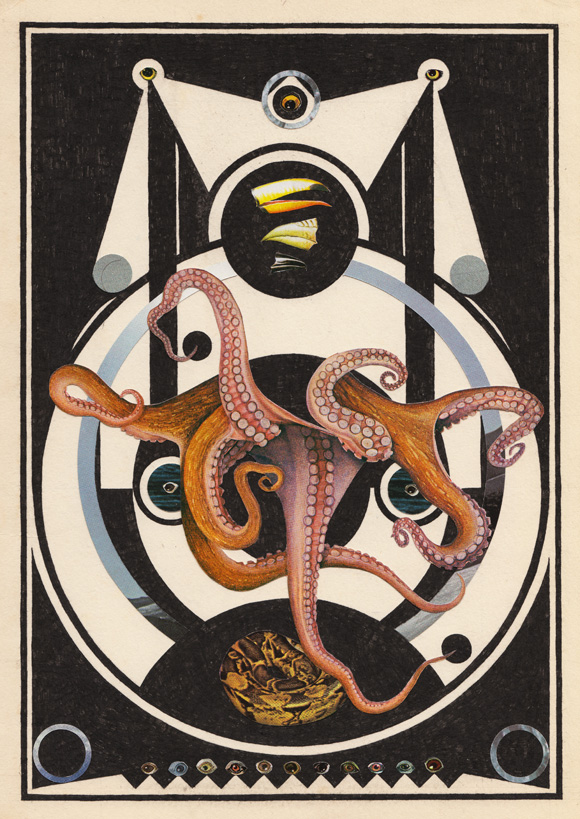
Issue Six Preview: Three Cataclysm Babies.

Annalemma Image 2 (Oneida, Ophilia, Ornella) copy

The following is an excerpt from the story Three Cataclysm Babies by Matt Bell, appearing in Annalemma Issue Six. Image by Joseph Wood.

Oneida, Ophelia, Ornella

My siren-daughters, my sweet-singing beauties: Whose songs pierce even the thickest of our soundproofed buildings, even the home that once they lived inside, when they were still part of my fractured family, still children under my care. Who, long before the floods began, once lined up beside their mother upon her piano bench, each daughter differing only in age and size, otherwise blessed with the same white-blonde hair, the same eyes so green they glittered even after the lamp-light was extinguished each night.

While their mother pressed each key in turn, these three daughters of mine hummed along, matching their voices to the piano’s percussion, to the tones that escaped its own upright body. One by one they captured its voice, contained it in their chests, so that soon we heard the piano even when no one was playing, its notes coming from our white-fenced yard, from their playroom, from the tight porcelain confines of their shared bath times.

It wasn’t until after the rains started that the oldest learned to make and mimic her mother’s mouth-noises, and so it was she who first licked her lips at the dinner table and then repeated every sonorous syllable of my wife’s long speech, the description of her day at the dykes, building dams with all the other mothers recently pressed into service, no longer allowed to stay home with their children. Soon the younger two could do as well as the oldest, all of them speaking in the mother’s many voices, matching the correct pitch and timbre that accompanied each shift of mood and mannerism.

How soon after did they learn to throw their own voices, to call out from places they could not possibly be? When did I first hear my wife’s words from every room, calling me to dinner, calling me to work, calling me to bed to make another daughter, so that the song might go on, might grow even fuller?

Click here to pre-order Issue Six, which ships April 12th.

Matt Bell is the author of How They Were Found, forthcoming from Keyhole Press in October 2010. His fiction appears in literary magazines such as Conjunctions, Hayden’s Ferry Review, Unsaid, and American Short Fiction, and has been selected for inclusion in Best American Mystery Stories 2010. He is the editor of The Collagist and can be found online at www.mdbell.com.

Joseph Wood has recently graduated from the University of Brighton and is currently practicing in London as freelance illustrator and creative image maker.

Thursday, March 18th

Issue Six Preview: A-hole in Germantown.

ahole_germantown_print_ready1 copy

The following is an excerpt from the story A-hole in Germantown by Mickey Hess, appearing in Annalemma Issue Six. Image by Charles Bergquist.

In fourth grade, Lynn was assigned to write to a pen pal in a foreign land. Her classmates chose Paris, or Australia, or Tokyo, places there were movies about. She chose Iceland. Why? Because she knew nothing about it, because neither did her classmates or even her teacher. Her pen pal correspondence with Halldor Laxness, Iceland’s most renowned novelist, was tacked to classroom walls. But it was overshadowed by the letters her classmates received.

Her friend Sarah received letters that were also carefully folded origami. Her name written in Japanese characters on ornate sheets of paper folded into swans. Lynn, on the other hand, received a bag of dried fish, stories about how Iceland was founded. She corrected these stories. She bought a pack of red gel pens and mailed the marked pages back to Reykjavik, referents corrected, tenses changed. Her mastery of the Icelandic language was remarkable, Laxness thought, particularly for a nine-year-old girl from Louisville,Kentucky.

Her concise paring of sentences, the way he came to rely on her editing: “now criticizing, now praising my work, but hardly ever letting a single word be buried in indifference.” But that last letter he got from her, just as the school year ended…

Dear Mr. Laxness,

This is the last letter I have to send you. You’ve been a good penpal. Keep writing. Most of your stories are good.

Sincerely,
Lynn

Thirteen years later, Halldor Laxness has moved to Louisville, Kentucky. Renowned novelists do this. After James Joyce published Ulysses, he moved there and opened a semi truck dealership. A lot of people don’t know that. Laxness has purchased a shotgun house in Louisville’s Germantown area. All his neighbors are officially unemployed, except for various entrepreneurial activities such as making and selling crystal meth or running perpetual yard sales. Once, a man tried to sell him a meatball sub out of the back of his Chrysler LeBaron.

Click here to pre-order Issue Six, which ships April 11th.

Mickey Hess is the author of Big Wheel at the Cracker Factory (Garrett County Press). His work has appeared in Quick Fiction, Ninth Letter, Pear Noir, and other journals. He is an associate professor of English at Rider University.

Charles Bergquist is a human man. He is a director, designer and photographer living in California. He loves the moon and hasn’t slept since 1998.

Tuesday, March 16th

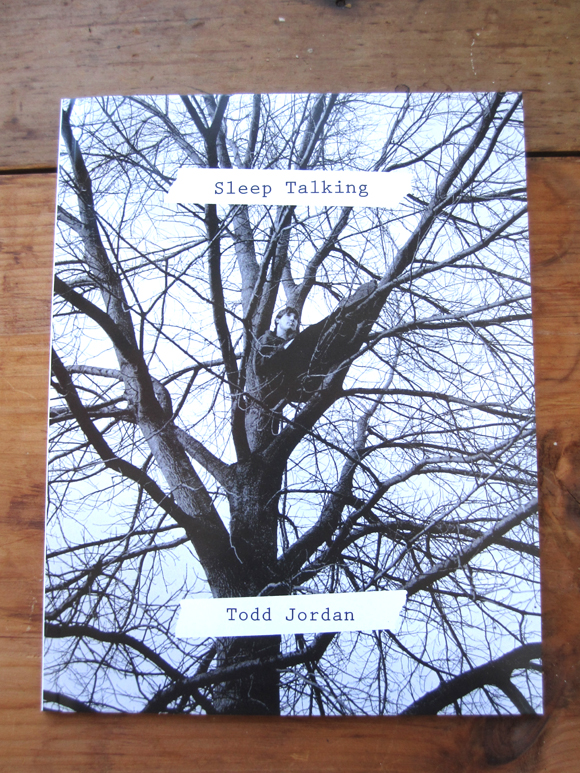
Sleep Talking.

IMG_4595

I was pleasantly surprised to see Issue Six contributor Todd Jordan’s new photo book sitting on my desk when I came into the office this morning.

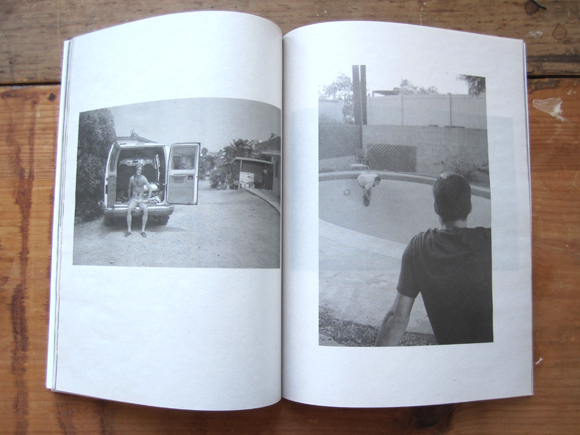
IMG_4596

A handsome and impressive collection I’m proud to add to the shelf. We need to get on Decathlon about updating their site, but for now head on over to Dashwood to purchase. Well worth it!

In other TJ news: he also keeps a Tumblr that will steal 10 15 minutes of your day.

Tuesday, March 16th

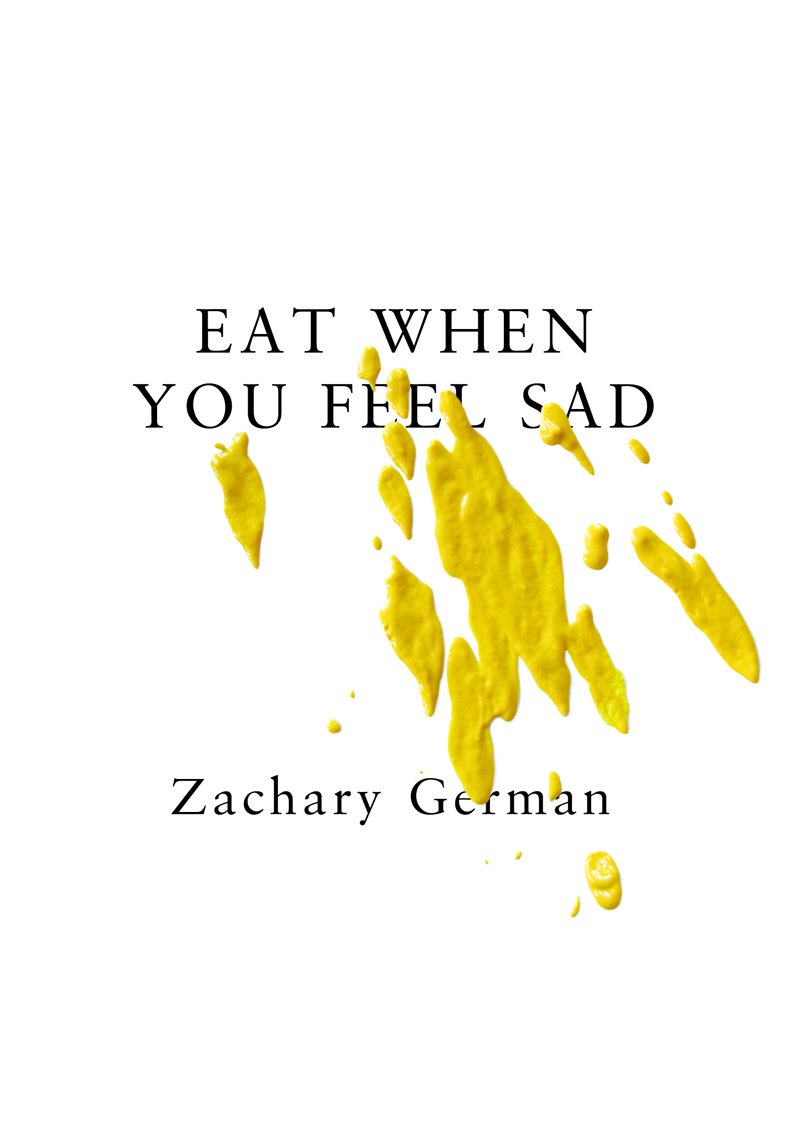
120 in 2010: Eat When You Feel Sad

EatWhenYouFeelSad

There’s a satisfying simplicity to the language in this book. When you feel sad you don’t really want to get fancy with language. When you’re hurt you don’t care about painting a picture. Those sorts of things don’t really matter to you at that point. When you’re sad, you just want to lay the facts on the table like puzzle pieces, to see if you can make any sense of it. And if there’s no sense to be made then sometimes the only thing that feels right is to sit and stare at the pieces.

YouTube Preview Image YouTube Preview Image YouTube Preview Image YouTube Preview Image

I thought it was bad to participate in these videos, like in order to purge yourself of these negative vibes you’re spreading them out into the world, infecting everyone who comes into contact with them. But it kind of makes you feel better, like like you’ve pooled your collective sadness into something ridiculous and funny in hindsight.

http://cn1.kaboodle.com/hi/img/2/0/0/e2/1/AAAAAkQPzk0AAAAAAOIdgw.jpg