






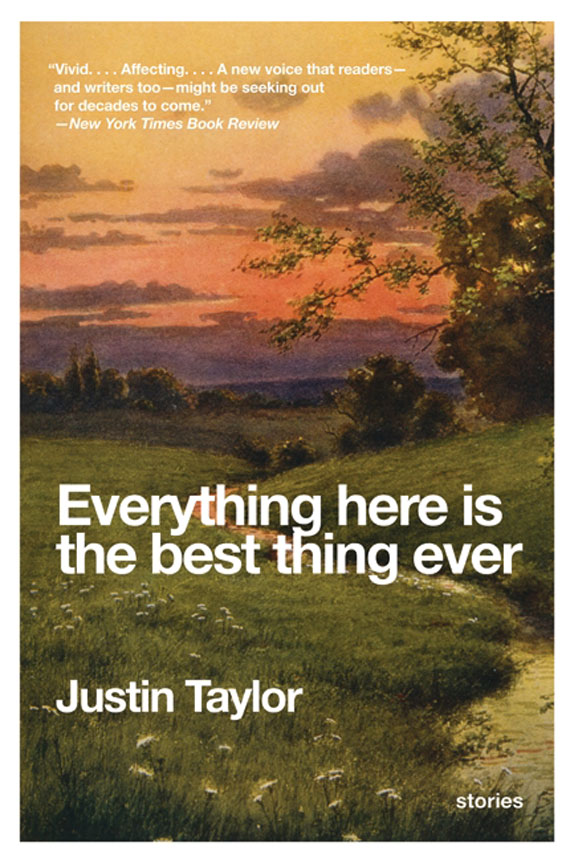
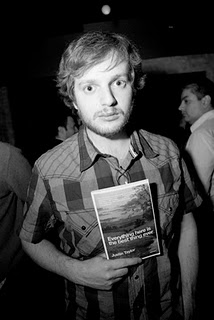
Justin Taylor is a contributor at HTMLGiant, editor of The Agriculture Reader and The Apocalypse Reader, and, most recently, author of Everything Here is the Best Thing Ever, a collection of stories centered around young people going through immense life changes. They fall in love, fall off roofs, do drugs, cast spells and get pregnant, mostly with Florida as the backdrop. This is what initially interested me in Taylor’s work, being a Florida boy myself. The stories nailed the feeling of spending your formative years in the deadly heat and I often found myself relating heavily to characters that wore flannel in an effort to be grunge, despite the 100+ degree weather. If you read this blog, live in Florida and love to read (and I know there’s a bunch of you) then I cannot recommend this book highly enough.
Justin and I emailed over a period of weeks concerning the topics of Florida punk rock, developing characters, anarchism and intersex fish. Enjoy.
***It’s like getting a glimpse of some secret society***
A: Would you say the crust-punk/anarcho scene in Gainesville exists because of No Idea Records?
JT: Mmm, it might be a chicken/egg question—like, did No Idea produce the scene or did the scene produce No Idea?—but No Idea has been around a long damn time, existing as an institution for what, in scene-terms, must be generations upon generations, so I think they deserve a lot of credit for surviving, growing, etc. and still doing that after all these years. Just organizing The Fest every year must be a massive undertaking. But punk politics are very weird, and get weird when you get into anarcho-punk. I lived in Gainesville from 2000-2004, so I was there when Against Me! was like the band in town—I mean we all just loved them—but then after Tom Gabel changed it up from a two-piece to a full band, and went from basically self-releasing to No Idea, there were a lot of people who really thought that they had “sold out.” Which is totally ludicrous, of course, but that’s the kind of logic that sometimes runs through scenes—anything that’s established at all is the enemy, or whatever. But even if they exist to some people as too “institutional,” I think they’re still playing a really important role in the lives of those people, as the thing that those people love to hate. Ultimately, however, community isn’t built up on three assholes’ opinions about when and whether a band got too famous. Community exists because the company still exists where it was founded, and is still independent, and employs locals, and pumps whatever it makes back into the same community it’s part of. So I can’t quite bring myself to meet you at “exists because of” but obviously I have massive respect for No Idea Records.
A: Did you listen to a lot of Hot Water Music at all?
I actually didn’t. I know some of their stuff, and I’ve seen them play a few times, but I don’t think I own any of their records. Before I lived in Gainesville, I think the only No Idea band I knew was Less Than Jake. And of course when you’re just listening to music and going to shows, you aren’t always keeping track of what bands are on what label—at least I wasn’t, but then I was never that dedicated to the punk scene; I’m not very good at being part of scenes, really, but I find them fascinating which is one reason I write about them. When I’m out somewhere and I can feel a real cliqueish or sceney vibe, it just captures my interest—it’s like getting a glimpse of some secret society that you really would not want to join but might happily watch a documentary on. Anyway, I pulled up the No Idea wikipedia page, so let’s see here, bands from this list I know for sure I saw (that I haven’t already mentioned)—Alkaline Trio, Army of Ponch, Asshole Parade, Atom & His Package, Defiance Ohio, Fiya, Ghost Mice, the Grabass Charlestons, Rumbleseat, This Bike is a Pipe Bomb, Twelve Hour Turn. Also, I should mention that I recognize several grindcore-verging bands I don’t think I ever saw, but which via my friend Jamie I definitely listened to: Trapdoor Fucking Exit, Combatwoundedveteran, Small Brown Bike. I think if you’re that kind of band, you have to have a three-word name.
A: I grew up in Orlando which was (and, to some degree, still is) a cultural wasteland. While I was in high school and just getting into books, the idea that any young writers of merit could come out of Florida seemed completely out of the realm of possibility to me. Now there’s you and Tao Lin. Do you think growing up in Florida shaped your writing in a negative or positive way?
JT: Hmm, there might have been a few before me and Tao Lin. Padgett Powell and Harry Crews come immediately to mind. Karen Russell, who wrote St. Lucy’s Home for Girls Raised by Wolves, is also from there. Oh and I don’t know if Lucy Corin, who wrote Everyday Psychokillers: A History for Girls, is actually from South Florida or not, but she does an excellent job with the territory in that novel.
I think that growing up in the part of Florida where I grew up did not have a particularly positive effect on my writing. It was a very stifling place in a lot of ways—not in the sense that it militantly enforced conformity or was censorious somehow, but more passively than that. People were generally disinterested in the arts, and literature in particular. I doubt I knew anyone (other than a teacher, maybe) who owned a book of poems—but this condition can hardly be unique to Florida. “Cultural wasteland” is the exactly correct description, though I hasten to add that that critique only extends to artistic and literary culture. I can’t speak for Orlando, but South Florida has enormous cultural diversity in terms of ethnicity. I grew up with a more ethnically diverse group of friends and acquaintances than almost anybody I met in college. I come from a big Jewish community, but within that there were people of Eastern European extraction, Cubans, Argentines—every variety of Hispanic and Latin American, really—plus African-Americans, Haitian-Americans, Indian, Persian, Israeli, Russian. I’m literally visualizing my high school debate class right now, and just going down the line.
Anyway, I credit my parents with a huge rule in shaping me as a writer. My father loves to write, and given half a chance would help with any essay, class presentation, or other homework assignment I was working on. His influence was immense, so much so that for most of my teenage years I refused to let him even see—much less help with—my writing, because I felt like I needed to find my own voice. I thought I would never be original unless I shut every other voice out. I’m much more comfortable with the idea of influence now, I even court it in many ways, and so it’s not a source of anxiety anymore. All originality is built on tradition, inheritance, etc. I can hear my father in the rhythms of my speech, sometimes; it’s still sort of uncanny, but hardly unwelcome. Anyway, both my parents were extremely supportive of my wanting to write—which I did from the very beginning. I’ve joked a lot in other interviews about how they pushed me to be a lawyer, or whatever, and there’s a shred of truth there but really just a shred. The larger and more real truth is that I always wanted to be a writer, and they pretty much never doubted me, or blinked.

***I write to find out what I’m writing about.***
A: Something I always like to hear about is the volume of writing an author does in contrast to what actually gets published. How many stories had you written before getting to the ones that are included in EHITBTE?
JT: Hundreds? A thousand? And that’s not counting all the poems and “novels,” both aborted and DOA. I’ve been writing since I was five years old, give or take, and I wrote with the conviction that I was writing for publication from probably about age fourteen or fifteen on. The earliest work good enough to be called “bad fiction” probably came about midway through my college years—a lot of misbegotten attempts at surrealism and/or “experimentalism,” mostly based on a profound misunderstanding of Donald Barthelme and a vestigial reverence for the Beats (not their actual writing, most of which is indigestible, but their “stance” or whatever: first thought least work, and all of that). Later, in grad school, I went through a long romance with short-shorts, and also with web-publishing, so a lot of material from this “era” is out there in the world. Some of those pieces I’m still proud of, as individual pieces (and others, it must be said, not so much). This book has fifteen stories in it. Offhand, I can think of two that might reasonably have been included, but weren’t—everything else, it was either stuff I’m ready to see consigned to oblivion or else it just didn’t fit with the book as I had come to envision it.
A: Short story collections are notoriously hard to get published, especially for new writers. What was your experience with the publishing process?
JT: It was difficult. Yes, story collections are hard in the best of times, and I went out with this collection during the fall of 2008. The financial crisis was unfolding, and publishing experienced its worst quarter in recorded history. Editors were getting laid off, or telling my agent that they loved the book but weren’t allowed to buy anything for the rest of the year. All kinds of things like that. It looked really ugly for a little while, but it’s definitely a case of all’s well that ends well. At the end of the day, you don’t need all of publishing to (1) love you, and be both (2) willing and (3) able to take a chance. You just need one person to have all three of those qualities at once, like a slot machine, except not random. Anyway, I found my guy. His name is Michael Signorelli. He was exactly the right editor for this book, and he’s editing my novel now. I’m also doing a photo-anthology for him, and hopefully after those projects are through we’ll come up with new reasons to keep working together. And that’s the story.
A: You take your time with a lot of these stories, setting up the characters, putting them in situations where they’re on a clear path to disaster and the big conflict or collision doesn’t happen until the middle or the end, which is in direct opposition to this instinct a lot of writers and editors (myself included) have these days of demanding that a story start with the conflict. What’s your theory on hooking a reader?
JT: If I had one, I’m not sure I’d be so quick to reveal it, but the fact is that I don’t. I try to write in a strong, clear voice that is valuable in and of itself, apart from what is or isn’t being described or said. It sounds trite, but it’s really true—I write to find out what I’m writing about. If I could identify the conflict etc. before I sat down to write the story, I wouldn’t bother. I’ll give you one example: the story “The New Life” was written based around two apparently unconnected scenes. The first was of a narrowly averted school-shooting, and the second was of a kid sitting by himself on a lip of concrete inside a drainage culvert, watching murky water float by. Over the course of attempting to connect those two scenes to each other, I wrote a story that had no place or need for either of them, but was ultimately much more compelling—to me, anyway.
A: What’s the fascination with anarchists? You mentioned earlier about your interest in scenes and cliques, but what is it about this one in particular?
JT: The anarchist scene arrests my attention because I used to be part of it, more than the punk scene or the anything-else scene. I lived in a house not entirely unlike the one where “Go Down Swinging” and “Estrellas y Rascacielos” are both set. I adopted anarchist values and ethos with my whole heart, or I tried to, and though my attempt at living those values never enjoyed more than a highly limited success, I identify that period and those beliefs as the time when I learned what it meant to really believe in something, period. So I have a relationship with anarchism that feels very much like what I imagine being a lapsed Catholic must feel like. I just finished a novel concerned with more or less these same subjects—religion, politics, politics-as-religion. It’s about anarchism and Christianity, and it’s set in a more fleshed-out version of the world described in these two stories.
A: I went through a writing program in a liberal arts college so there was a hand full of young men trying to write their own versions of anarchist-bike-messenger-punk-rock characters, but they were ultimately unsuccessful because the characters were just too off the wall, cartoonish parodies, not real people. I think the characters in EHITBTE work because they’re people first and part of scene second. Would you say that’s a fair assessment of how you approach your characters?
JT: Yes, I do think that’s a fair assessment—more than merely fair; I take it as a high compliment. If the characters come off like cartoonish parodies (when they’re not supposed to; natch) it’s probably because the writer secretly doubts the humanity of those people as people. That is, he doesn’t regard them as real in the same way he regards himself as real. He knows just enough to know that he should, but that’s as much as he knows–and a little bit of knowledge can be a very dangerous thing. I spend a lot of time developing characters, far more time than I do developing plots or “conflicts” or whatever, and the way I develop them is by watching them in action. If these stories were movies, the “deleted scenes” would span several hours for each one. I don’t know if that’s good or bad, it’s just how I work. Since I already mentioned “The New Life,” I may as well use it as an example again. I can’t tell you how much material I wrote for that story and didn’t use—scenes where Brad, Kenny, Angela and Zak Sargent are all driving around in a car together, getting stoned; scenes where Brad is fantasizing about being with Kenny and Angela at the same time. I don’t even remember what else, though it’s all in files somewhere on this computer. It doesn’t bother me an iota that that stuff ended up not getting used in the final draft. It made those characters real to me, and to each other, which is what made it possible for the story to finally arrive where it did. Let me put it another way: as far as I’m concerned, all that stuff did get used. Just because nobody else can see it doesn’t mean it isn’t there.
***It’ll be like going to India!***
A: You seem to have a reputation on HTMLGiant for occasionally lashing out at specific writers with eloquently worded take-downs of their work. Do you worry that this public voice of yours could possibly overshadow your fiction writing voice, subsequently deterring people from reading your books?
All criticism is personal and idiosyncratic–this is probably the single most important and least-understood thing that Harold Bloom teaches us. My likes and dislikes, and my biases and my mistakes (and, hey, why not–my resounding triumphs) and my changes of heart etc., all taken in aggregate may or may not tell you something about “the literary world today,” but they will damn sure tell you something about me, Justin Taylor. If you like what you are hearing, that is, if I seem to you like a competent guide, then you may invest your trust in me to tell you why writer A is extremely important and wonderful, whereas writer B is not. If I seem to mostly love things you hate, and vice versa, then perhaps I am not the critic for you–or maybe my taste makes an interesting contrast to yours. There are many ways for a critic to be useful to a reader, and to literary culture in general. Some things are worth affirming–really advocating for. Most things aren’t worth commenting on at all, and my basic philosophy, believe it or not, is live and let live. I’m not the literature police and don’t want to be, but when we’re talking about a space like HTMLGiant, where every contributor has free reign to speak on “behalf” of the blog in general, and invest anything they choose with its full cultural “authority” and “blessing,” then there’s a really legitimate pragmatic concern about what you’re going to wake up on any given day and find your name affiliated with. There are some things I find so unworthy and/or odious that I want to be on-record against them, (1) because the kind and degree of bullshit they are peddling should not be allowed to stand unchallenged, and (2) so that anyone reading the site for the first time today, or poring through its archives 5/15/50 years from now will see that there was not a consensus, but rather a fierce and informed dissent and argument about the relevance and quality of person or idea or book X. It’s a testament to HTMLGiant itself that it can withstand these kind of arguments, especially since it’s all hashed out in public, rather than in some weekly editorial meeting where the internal dissent never makes it out of the conference room.
A: I was going to conclude with a question regarding the direction you see publishing heading, but it feels more pertinent to ask you, as a writer, what direction do you see the world heading?
JT: The world’s a big place. There’s a lot to be optimistic about, and a lot to be scared shitless over. There’s a “best of times, worst of times” thing going on. The Gordon Lish Collected Fictions is out now–that’s good news. Did you see the thing about how all the water in DC has become a “toxic stew” that’s turning all their fresh water fish intersex? That seems like not such good news, especially since AWP is in DC next year. I guess I’ll be bringing bottled water to the conference. It’ll be like going to India!
Click here to for more info on Justin and Everything Here is the Best Thing Ever.